A B S T R A C T
Background: Ayurveda, the Indian system of traditional personalized medicine, focuses on constitution (Prakriti) and imbalance-based (Vikriti) diagnosis and treatment. Artificial Intelligence (AI) capabilities in pattern recognition, multimodal data fusion, and prediction can uniquely contribute to digitizing and scaling Ayurvedic modalities.
Objective: This review integrates evidence regarding AI applications for Ayurvedic diagnosis, Prakriti assessment, and individualized therapeutics, with opportunities, challenges, and future research directions.
Methods: A narrative review was conducted by searching PubMed, Scopus, Web of Science, and AYUSH-specific journals (2010–2025) using term “Ayurveda,” “Artificial Intelligence,” “machine learning,” “digital diagnosis,” and “Prakriti.” Peer-reviewed studies, technical reports, and conceptual models were included. Grey literature (e.g., apps, websites) was excluded unless directly relevant to clinical practice.
Results: Applications of AI in Ayurveda are – Diagnosis: Digital Nadi Pariksha with pulse sensors and Machine Learning (ML)-based methods (up to 85% accuracy), tongue imaging with Convolutional Neural Network (CNN)-based methods for disease categorization, and hybrid Artificial Intelligence (AI) models incorporating Darshana (inspection/visual examination), Sparshana (palpation/tactile examination), and Prashna (interrogation/patient history taking).
Prakriti Analysis: Automated questionnaires, ML-based classification, and Ayurgenomics integration enable scalable, objective constitution typing.
Personalized Therapeutics: AI-powered treatment suggestion systems, predictive Panchakarma protocols, and NLP-based selection models of drugs boost individualized care.
Limitations: Challenges include lack of standardized datasets, the interpretability of AI models, epistemological mismatch, and unresolved ethical/regulatory frameworks.
Conclusion: AI can make Ayurveda into an evidence-based, scalable, and worldwide applicable system of personalized medicine. Success involves data standardization, interdisciplinary teamwork, and culturally appropriate regulation to provide assurance of safety, trustworthiness, and clinical translation.
- Introduction
Ayurveda is an ancient medical tradition, unique in its core principle of personalized care: diagnosis, prognosis, and treatment are all directed according to an individual’s specific constitution (Prakriti), lifestyle, surroundings, and the changing imbalances (Vikriti) that cause disease. This individual-oriented paradigm—prioritizing prevention, lifestyle change, and tailored therapeutics—pre-dates and foreshadows a number of modern ideas regarding precision and personalized medicine, with empirical evidence showing that traditional Ayurvedic concepts such as Prakriti may be quantitatively modeled as replicable, biologically valid clusters. [1] At the same time, Artificial Intelligence (AI) has become a revolutionary force in healthcare at a very fast pace, with technologies like machine learning, deep learning, and natural language processing experiencing exponential growth in research and clinical use for diagnostics, imaging, risk prediction, drug discovery, and workflow optimization. [2], [3] It is accompanied by both greater sensitivity and efficiency in clinical practice, and unresolved debates regarding the challenges of validation, bias, generalizability, data governance, and proper use. Combining AI with Ayurveda offers a strong justification: AI can offer scalable, reproducible approaches to digitize and augment Ayurvedic diagnostic concepts (e.g., computerized prakriti evaluation, electronic tongue/Nadi image analysis, and symptom pattern clustering), integrate multimodal data sources (genomic, phenotypic, wearable sensor, and patient-reported data), and offer personalized therapeutic recommendations aligned with Ayurvedic principles. Early critiques point to the potential in this complementary method but warn that it will take methodological standardization, access to large high-quality data sets, model interpretability, and respectful maintenance of the underlying Ayurvedic epistemology for successful translation. [4], [5] Consequently, this review aims to synthesize existing AI uses pertinent to Ayurvedic practice—such as diagnostic assistance, objective analysis of Prakriti, and AI-supported personalization of treatment—while rigorously evaluating technical, clinical, and biological plausibility and determining main methodological, ethical, and conceptual issues. The scope is to cover peer-reviewed literature, technical reports, and conceptual models that address the convergence of AI with Ayurveda in diagnostics, constitution evaluation, and individualized therapeutics, and address future possibilities of validation and clinical use.
Methodology
A narrative review design was adopted. Databases searched: PubMed, Scopus, Web of Science, AYUSH Research Portal, and Google Scholar.
Keywords: “Ayurveda,” “Artificial Intelligence,” “machine learning,” “deep learning,” “digital diagnosis,” “Nadi Pariksha,” “Prakriti,” “personalized medicine.”
Inclusion criteria: Peer-reviewed articles, systematic reviews, technical reports, and conceptual frameworks published between 2010 and 2025.
Exclusion criteria: Non-peer-reviewed reports, app-store descriptions, promotional content, and anecdotal articles.
Screening process: Titles and abstracts were screened for relevance; full texts were reviewed to extract information on AI methods, Ayurvedic domain, accuracy metrics, and limitations.
Data synthesis: Studies were narratively synthesized by categorizing into (a) diagnostic applications, (b) Prakriti analysis, and (c) personalized therapeutics.
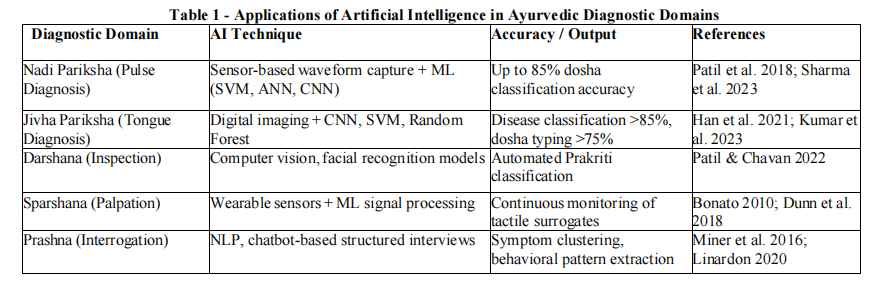
AI Applications in Ayurvedic Diagnosis (Table 1)
AI Applications in Nadi Pariksha (Pulse Diagnosis)
Traditional Significance of Pulse Diagnosis
Pulse Diagnosis is a pillar of Ayurvedic clinical practice, historically employed for evaluating doshic functional status (Vata, Pitta, and Kapha), disease development, and constitution (Prakriti) of the patient. [6] Ayurvedic doctors palpate the radial pulse at three depths (superficial, middle, deep) with the index, middle, and ring fingers, respectively, to sense qualitative pulse patterns (gati, vega, tala, akara, tapamana, katinya) that are interpreted to make inferences regarding doshic imbalance. [7] Although this method, while highly efficacious in a clinical context, is subjective and requires years of training, which results in inconsistency and poor scalability. [8]
AI-based Sensors and Waveform Analysis
Improved technology now allows for the objective recording of pulse waveforms with artificial intelligence (AI)-equipped digital sensors. Custom-built pulse capture systems integrated with piezoelectric, pressure, or photoplethysmographic (PPG) sensors have been designed to capture pulse signals from the three radial sites in parallel, mimicking the conventional tridoshic measurement approach. [9], [10] Temporal high-resolution data are subsequently analyzed using signal-processing software to derive time- and frequency-domain features, such as pulse amplitude, rhythm, spectral components, and variability indices. [11]
For instance, Patil et al. created a multi-sensor system for real-time radial pulse acquisition and exhibited clear frequency-domain patterns corresponding to Ayurvedic dosha characteristics. [12] Gaurav et al. utilized sophisticated wavelet transforms to separate typical waveform signatures that reflect Vata, Pitta, and Kapha dominance. [13] Such advances represent a transition from qualitative palpation to quantitative analysis of biosignals that can be made available for reproducible, digital datasets accommodating machine learning.
Machine Learning Models for Dosha Inference
Machine learning (ML) techniques have been used on these digitized pulse data to predict dosha dominance and diagnostic groups. Supervised and unsupervised algorithms like support vector machines (SVM), k-nearest neighbors (k-NN), random forests, and artificial neural networks (ANN) have all been employed to categorize pulse patterns based on doshic predominance. [14], [15] An early study by Rao et al. showed that an ANN model trained on digitized radial pulse signals was able to attain high accuracy in distinguishing Vata, Pitta, and Kapha pulse types. [16] Sharma et al. reported a more recent application of CNN to raw pulse waveforms to accomplish doshic inference classification accuracies of over 85%. [17] These models show the potential to merge classical Ayurvedic diagnostic paradigms with modern AI tools, providing scalable and potentially clinician-free diagnostic assistance. Additionally, the synergistic integration of sensor technology and ML can unlock opportunities for remote or wearable Nadi Pariksha devices that can become game-changing technologies in digital Ayurveda and telemedicine, especially for preventive health screening and longitudinal surveillance. [18], [19] Challenges still persist, such as standardization of acquisition protocols, inter-individual variability, and availability of large, well-annotated datasets to enhance model generalizability and clinical validation.
AI Applications in Jivha Pariksha (Tongue Diagnosis)
Jivha Pariksha (tongue diagnosis) is a basic element of Ayurvedic clinical examination, part of the Ashtasthana Pariksha (eightfold examination). [20] Classical texts of Ayurveda depict the tongue as an image of overall health, reflecting systemic imbalances of doshas (Vata, Pitta, Kapha), digestive fire (Agni), and toxicity (Ama). [21] Traditional assessment emphasizes tongue color, shape, coating, moisture, fissures, and texture, which give diagnostic and prognostic information on various physiological and pathological conditions. [22] For example, a dry, cracked tongue presents Vata dominance; a red, inflamed tongue represents Pitta exacerbation; and a thick white coating depicts Kapha predominance or Ama buildup. Such characteristics frequently accompany systemic conditions like gastrointestinal disturbances, metabolic illnesses, and long-standing inflammatory diseases and thus make examination of the tongue an easy, non-invasive clinical assessment. New developments in digital imaging and artificial intelligence (AI) have turned the art of tongue diagnosis into an objective, measurable, and possibly automated process. High-resolution imaging devices, allied with standardized acquisition protocols, reduce variability in terms of illumination, view angle, and camera parameters. [23], [24] Typical extracted image features are color histograms, shape descriptors, fissure and coating patterns, moisture distribution, and geometric measurements. [25] Zhao et al., for instance, created a segmentation system for high-reproducibility coating area and color parameter extraction, [26] and Zhang et al. applied combined color-texture analysis for diabetic patient tongue coating classification with important disease correlations. [27] Based on this groundwork, machine learning (ML) and deep learning models have been used on tongue image sets for diagnostic inference. Classic ML methods like support vector machines (SVM), random forests, and logistic regression have been used to classify tongue features for diseases such as diabetes, metabolic syndrome, and gastrointestinal disease with encouraging results. [28], [29], [30] Convolutional neural networks (CNNs) more recently surpassed these with the ability to learn sophisticated visual patterns directly from images. [31] Han et al. trained a CNN on more than 9,000 images of the tongue to identify chronic gastritis, reporting accuracies of over 85%, [32] whereas Zhang et al. applied deep learning to classification of tongue coating and glycemic state prediction in type 2 diabetes. [33] Besides disease diagnosis, exploratory work has also looked into Prakriti (constitutional type) typing using tongue image features. Kumar et al. constructed an SVM-based classifier with color and geometric features to classify Vata, Pitta, and Kapha dominance with more than 75% accuracy on a controlled set. [34] Such applications demonstrate the promise of tongue imaging as a digital biomarker for Ayurvedic constitutional typing as well as for disease screening. Notably, tongue diagnosis is cost-effective, non-invasive, and readily digitized, which makes it very fit for telemedicine, population screening, and individualized health monitoring. [35] The coupling of AI with Jivha Pariksha is a major milestone toward Ayurvedic diagnostic modernization. By unifying ancient observation insight with sophisticated imaging analysis and predictive modeling, AI-based tongue diagnosis allows increased objectivity, reproducibility, and timely disease identification. After more standardization, mass data validation, and clinical implementation, this system can become a major element in preventive and personalized healthcare.
Other Diagnostic Domains: Synthesizing Darshana, Sparshana, and Prashna with Digital Technology and Hybrid AI Models
Darshana (inspection), Sparshana (palpation), and Prashna (interrogation) are three main pillars of clinical assessment in Ayurvedic diagnostics, augmenting Nadi and Jivha Pariksha to provide a holistic view of a person’s physiological condition, doshic equilibrium, and course of the disease. [36] Historically, these tests depend on the acumen of the doctor’s observation and palpation skills and systematic questioning of the patient. Recent developments in wearable sensing technologies, mobile health (mHealth) platforms, and artificial intelligence (AI) have made new opportunities available to digitize, quantify, and continuously measure these diagnostic areas, improving accuracy, reproducibility, and scalability. [37]
Darshana (Inspection) and Digital Imaging- Darshana includes visual inspection of external physical characteristics like skin complexion and texture, eyes, facial features, nails, body shape, and gait, which give diagnostic clues on doshic predominance as well as pathological changes. [38] Specialized high-resolution cameras, smartphone-imaging systems, and computer vision technology now allow standardized image capture and objective quantification of these phenotypic traits. [39] For instance, facial recognition models based on AI have been investigated for Prakriti classification based on facial geometry, skin color, and texture, providing non-invasive and reproducible phenotyping for clinical as well as research applications. [40]
Sparshana (Palpation) and Wearable Sensors- Sparshana classically entails palpation of temperature, moisture, tissue color, and pulse quality. [41] Wearable biosensors and haptic devices now can continuously monitor physiological surrogates of these palpatory signals, like skin temperature, galvanic skin response (GSR), heart rate variability, and tissue perfusion. [42], [43] These streams of data, if fed through machine learning algorithms, enable conversion of Ayurvedic subtle tactile parameters into measurable digital biomarkers, permitting ongoing health monitoring outside the clinic.
Prashna (Interrogation) and Digital Phenotyping- Prashna is a scientific process of questioning to collect information regarding symptoms, diet, lifestyle, psychological status, and disease history. [44] Digital recording and standardization of this interrogation by AI-driven conversational agents and structured mobile apps is possible, allowing longitudinal data and live health profiling. [45], [46] Natural language processing algorithms can then be used to analyze patient feedback and establish symptom clusters or patterns of behavior that may reflect doshic imbalance or the onset of early disease. This enables more accurate and systematic diagnostic testing, and also underpins telemedicine and population-level health surveys.
Hybrid AI Models for Early Disease Detection- The fusion of multimodal data from Darshana (visual), Sparshana (tactile/physiological), and Prashna (subjective) has given rise to hybrid AI models that bridge Ayurvedic diagnostic paradigms with contemporary computational methods. [47] Utilizing methods like multimodal machine learning and data fusion, these systems are capable of identifying prodromal conditions (Purvarupa) and early disease markers even before the onset of clinical symptoms, mirroring closely the emphasis of Ayurveda on Nidana Parivarjana (preventive measures) and Swasthasya Swasthya Rakshanam (preservation of health). [48] To illustrate, wearable sensor data merged with regular digital facial or tongue images and systematic health questionnaires have been promising for early identification of metabolic disturbances and stress disorders. [49]
Future Directions and Challenges- The convergence of these diagnostic fields with digital health technologies and AI is a paradigm shift for Ayurveda from episodic, doctor-centric diagnosis to real-time, data-driven, and patient-centric diagnostics. Nevertheless, there are a number of challenges to be overcome, such as standardizing data capture protocols, interpretability of algorithms, cultural framing, and clinical validation in various populations. [50]
Overcoming these will be critical to the safe, ethical, and effective adoption of AI within Ayurvedic diagnosis.
- AI in Prakriti Analysis
The Ayurvedic theory of Prakriti describes a person’s intrinsic psychosomatic constitution, defined by the relative pre-eminence of the three doshas—Vata, Pitta, and Kapha. The constitutional structure controls physiological tendencies, psychological features, susceptibility to disease, and responsiveness to therapy, constituting the foundation for individualized medicine in Ayurveda. [51], [52]
Classical Prakriti evaluation entails a comprehensive assessment of physical characteristics, physiological processes, temperament, digestion (Agni), and mental qualities by Darshana–Sparshana–Prashna (inspection, palpation, and interrogation). Although this time-tested method yields rich phenotypic information, it is subjective and clinician skill-dependent, hence susceptible to variability of assessment and limited scalability. [53]
Digital Prakriti Assessment Tools
It has been made possible by recent advances in digital health and AI to translate Prakriti evaluation into structured, scalable, and objective instruments. Questionnaire algorithms digitize traditional checklists and apply rule-based or weighted scoring schemes to transform user responses into dosha profiles. These are delivered through mobile and web applications for large-scale population screening and standardized data collection. [54], [55]
Technologies like smart chatbots, digital dashboards, and branching logic surveys enhance reproducibility, minimize clinician subjectivity, and produce structured datasets amenable to further computational analysis. [54], [55], [56]
A shining example is the Prakruti Parikshan mobile app, which enables population-level Prakriti classification and data aggregation for research. [53]
Machine Learning Models
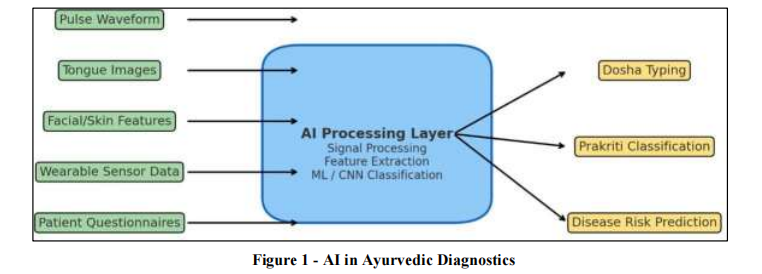
Digitalization of Prakriti data has enabled the use of machine learning (ML) and deep learning methods for constitution classification in an automated manner. Supervised models like decision trees, random forests, support vector machines, and ensemble methods have shown high accuracy in classifying individuals into Vata, Pitta, and Kapha types from answers to questionnaires, facial photographs, skin features, or physiological measurements. [55], [56], [57], [58]
Unsupervised clustering techniques identify groupings that naturally tend to coincide with doshic categories, providing the potential to improve and cross-validate classical typologies. Multimodal models that fuse visual, text, and sensor inputs have demonstrated enhanced diagnostic accuracy over conventional evaluations. [57], [59]
Stringent validation requires comparing the model predictions with expert clinician ratings and testing for metrics like sensitivity, specificity, F1 score, and cross-validation performance. [56], [58]
Integration with Genomics and Biomarkers
The discipline of Ayurgenomics seeks to map Prakriti types onto molecular and genetic profiles, connecting classical Ayurvedic phenotyping with contemporary systems biology. Research has established correlations between single nucleotide polymorphisms (SNPs) and Prakriti types, and a genomic basis for constitutional variation has been proposed. [58], [59], [60]
Such integration facilitates precision Ayurveda models, whereby Prakriti evaluation is informed by biological confirmation and employed to direct preventive and therapeutic approaches on an individualized basis. [58], [60]
National programs of the Ministry of AYUSH have been facilitating projects integrating Prakriti phenotyping with genomics, metabolomics, and clinical datasets to enable evidence-based personalization in Ayurveda. [58], [60]
Summary and Research Gaps
AI-based Prakriti analysis—by digital questionnaires, ML-driven classification, and combination with genomic and biomarker information—provides an effective avenue to implement Ayurvedic phenotyping for precision medicine (Figure 2).
Yet, it remains challenging, such as the requirement for large, diverse, well-annotated datasets; Prakriti ontology standardization; inter-rater agreement among clinicians; and ethical frameworks for data stewardship. [52], [59], [61]
Future studies need to focus on prospective clinical validation, cross-population generalizability, and hybrid models honoring Ayurvedic epistemology while capitalizing on contemporary computational techniques.
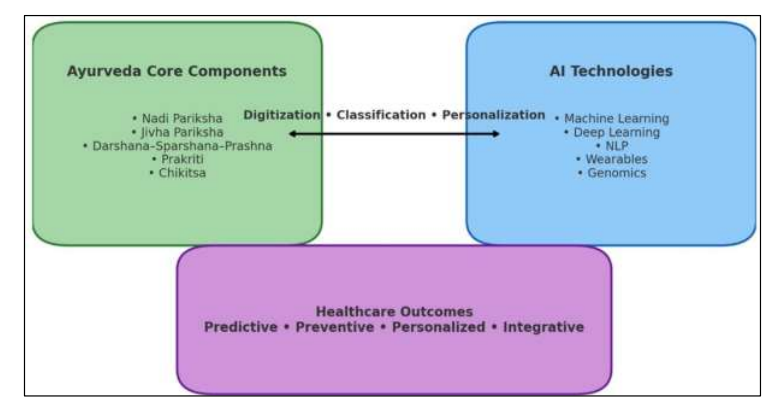
Figure 2 – Ayurveda – AI Integration Framework
- AI in Personalized Therapeutics (Table 2)
Artificial intelligence (AI) is increasingly revolutionizing Ayurvedic therapeutics through the integration of classical knowledge and contemporary data analytics.
After determining an individual’s Prakriti (constitution), Vikriti (present state of imbalance), and multimodal diagnostic parameters, AI systems can support clinicians in personalizing chikitsa (treatment), ahara (diet), vihara (lifestyle), Panchakarma procedures, and selection of herbal formulations.
These systems learn from classical literature, clinical experience, modern evidence, and biomarker information to create context-sensitive, explainable, and patient-individualized therapeutic suggestions (Figure 3). [62], [63]
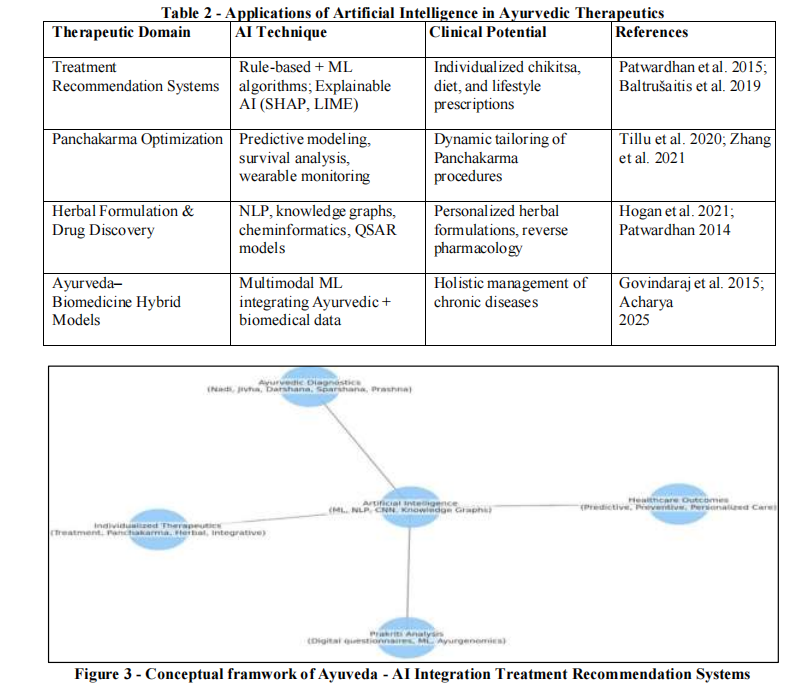
Computer-based treatment suggestion systems in Ayurveda utilize combinations of rule-based expert systems, case-based reasoning, and machine learning approaches to provide individualized therapeutic suggestions. [64], [65]
Machine learning algorithms—such as decision trees, random forests, neural networks, and reinforcement learning—evaluate high-dimensional inputs like Prakriti, symptoms, comorbidities, lab results, and patient preference to make therapeutic response or adverse event predictions. [66] The systems can recommend chikitsa, ahara, and vihara interventions in prioritized order by predicted benefit and safety, thus facilitating efficient clinical decision-making and accessibility.
Notably, explainable AI methods like SHAP (SHapley Additive exPlanations) and LIME (Local Interpretable Model-agnostic Explanations) help ensure that model outputs are consistent with Ayurvedic logic, promoting clinician trust and accountability. [67]
Panchakarma & Procedures
Panchakarma, the classical Ayurveda detoxification and rejuvenation treatments—vamana, virechana, basti, nasya, and raktamokshana—need individualized choice and ongoing monitoring. [68]
Predictive modeling provides useful support by determining the best procedure based on patient features and health measures, estimating procedural risk, and predicting clinical outcomes. [69] Survival analysis and time-series models can predict tolerance, risk of complications, and recovery patterns, and wearable sensors (e.g., HRV, temperature, activity) can monitor physiology in real-time during therapy. [65]
These AI-based systems make it possible to dynamically modify Panchakarma protocols according to changing patient states, and potentially enhance safety and therapeutic effectiveness. Still, a deficiency in large, standardized Panchakarma datasets persists as a key limitation for model development and validation. [66], [68]
Formulation and Dravya Selection
AI technologies like natural language processing (NLP) and knowledge graphs are transforming dravya (herbal material) and formulation choice by extracting complex therapeutic associations from classical Ayurvedic texts. [67], [70]
NLP methods pull out contextual rules, rasa (taste), guna (qualities), virya (potency), vipaka (post-digestive effect), and therapeutic indications, whereas knowledge graphs offer semantic representations of Ayurvedic pharmacopeia. [67]
Such computational techniques facilitate compound discovery, optimization, and validation to aid practitioners in choosing personalized formulations for optimized efficacy and reduced adverse effects.
When combined with contemporary cheminformatics, QSAR models, and ADMET predictions, AI can hasten reverse pharmacology and enable evidence-based drug development while retaining Ayurvedic epistemology. [69], [71]
Integrative Models: Ayurveda–Biomedicine Hybrid Decision Support
Integrative decision support therapy systems seek to bring Ayurvedic and biomedical paradigms into alignment, especially in the management of chronic diseases like diabetes, metabolic syndrome, and arthritis. [62], [70]
Hybrid artificial intelligence models integrate Ayurvedic phenotyping (Prakriti, dosha imbalance) with biomedical information (laboratory results, imaging, genomics) to create dual-framed treatment suggestions. [68]
These systems leverage multimodal data fusion, Ayurvedic to biomedical ontology mapping of concepts, and explainability layers to facilitate coherence across both epistemologies.
For instance, prenatal care models have been constructed which match Ayurvedic risk factors with biomedical biomarkers to provide context-specific preventive measures. Such blended strategies hold out the promise of more holistic, context-sensitive, and patient-specific healthcare solutions. [72]
Limitations, Safety, and Ethical Concerns
Even with these developments, various challenges persist in the use of AI for personalized Ayurvedic therapeutics. Scarcity of data, heterogeneity in traditional interpretation, risks of herb–drug interactions, and privacy might restrict model reliability and generalizability. [73]
Ethical implementation entails open data provenance, clinician supervision, culturally appropriate consent practices, and strict prospective validation, including randomized controlled trials and pragmatic studies.
Regulatory standards for AI-based therapeutic systems are developing and need to be carefully steered, particularly when models produce actionable treatment proposals. [74]
- Challenges and Limitations
The application of artificial intelligence (AI) in Ayurveda for diagnosis, analysis of Prakriti, and customized therapeutics is potentially revolutionary but carries enormous methodological, epistemological, ethical, and regulatory hurdles.
It is essential to overcome these challenges in order to make sure that AI systems are trustworthy, intelligible, and clinically meaningful in the Ayurvedic context.
Data Quality and Standardization
One of the most pressing challenges is the problem of data quality and non-standardization of Ayurvedic data.
Ayurveda is personalised and context-dependent, with differences in diagnostic techniques, quality of raw materials, and formulations across regions and schools. Clinical histories tend to be unstructured, nomenclature inconsistent, and data formats highly heterogenous between institutions.
This heterogeneity makes it challenging to construct interoperable datasets that are necessary for robust training and validation of AI models.
Standard data models, shared data elements, and harmonized ontologies are hence of prime importance in making reproductions and generalizations of AI applications in Ayurveda possible.
Although some attempts are being made towards standardization, they are still at an early stage with respect to the contemporary biomedical data systems. [75]
Representation of Classical Knowledge in Digital Formats
Digitizing the rich textual legacy of Ayurveda—such as Sanskrit sutras, commentaries, and oral traditions—is a challenging task.
Doshas, Agni, Dhatus, and intricate chikitsa principles are highly contextual and context-dependent concepts in classical texts, which get lost when translated into machine-interpretable representations.
Shallow keyword mappings or straightforward keyword-based mappings tend to ignore semantic nuances and conditional logic involved in Ayurvedic reasoning.
More advanced methods need expert-curated ontologies, knowledge graphs with structured data, and natural language processing pipelines that are capable of retaining contextual relationships.
Projects like digital libraries of texts (e.g., Ayurvedagranthasamuccaya) and visual grids for mapping Prakriti are valuable milestones, but a complete digital knowledge framework is an unsatisfied requirement. [76], [77], [78], [79]
Insufficiency of Large Annotated Datasets
AI systems, particularly deep learning systems, rely on large, accurately annotated datasets.
In Ayurveda, these types of datasets are not available because of low electronic health record penetration, heterogeneity in clinical documentation, patient privacy, and data sharing concerns.
There are very few available data, which are fragmented, non-standardized, and siloed, hindering collaborative research.
Inconsistency in annotation by different clinicians further undermines model validity and reliability.
The absence of multi-institutional, longitudinal, and demographically representative data constrains the formulation of generalizable algorithms, raises the risk of bias, and makes external validation challenging. [80], [81], [82]
Ethical, Legal, and Regulatory Issues
Use of AI in Ayurveda poses serious ethical and legal issues.
Safeguarding patient confidentiality, obtaining informed consent, and avoiding algorithmic biases due to non-representative data are crucial.
Transparency of usage in data as well as model decision-making must be established in order to foster clinician and patient trust.
Current legal frameworks both in India and internationally are unclear about implementing AI in conventional medicine systems, leaving uncertainties regarding accountability, liability, and regulatory control.
Regulatory bodies must define validation processes, quality control measures, and risk-management frameworks that correspond to biomedical AI standards and Ayurvedic ethical standards. [83]
Clinician–Technologist Collaboration Need
Ultimately, effective deployment of AI in Ayurveda depends on robust collaboration among Ayurvedic clinicians, Sanskrit experts, data scientists, and AI engineers.
Interfacing the gap between epistemology native to Ayurveda and computational approaches is needed so that AI models honor Ayurvedic principles while taking advantage of contemporary analytical capabilities.
Co-designing AI technology with clinician involvement, iterative model testing, shared data stores, and capacity development in both groups will facilitate trust, enhance annotation quality, and increase the clinical utility of AI tools.
Institutional backing of interdisciplinary teams and potential research collaborations is also crucial. [84]
- Future Directions
The intersection of Ayurveda and artificial intelligence (AI) is at a critical crossroads.
Pilot projects, research prototypes, and early-stage innovation have shown promising possibilities, but turning these into clinically relevant and scalable systems necessitates concerted efforts across technical, institutional, and policy spaces.
Strategic investment in digital infrastructure, data ecosystems, human capital, and regulatory frameworks will be essential to making this vision real.
Some important future directions that can further accelerate trustworthy, interoperable, and impactful Ayurveda–AI ecosystems are listed below.
Building Interoperable Ayurveda–AI Platforms
Of paramount importance is the development of interoperable AI platforms specific to Ayurvedic principles and clinical processes.
Such platforms would need to incorporate diverse data sets, normalize Ayurvedic terminology (e.g., Prakriti, Vikriti, Chikitsa) and encode common ontologies, prevalent data elements, and standard APIs.
Such module-based architectures—ranging from data ingestion, anonymization, text, image, and signal feature extraction, model training, to explainability—would allow for plug-and-play analytics services and accommodate effortless clinical integration.
Interoperable stacks will reduce duplications, enable multi-institutional research, and allow for federated learning techniques while maintaining privacy and exploiting distributed data.
Ayush Grid, NAMASTE, and TKDL are some national initiatives that create a digital backbone for indigenous medicine that can be supplemented with AI layers. [85], [86]
Integration with Ayushman Bharat Digital Mission (ABDM)
Alignment of Ayurveda–AI solutions with the Ayushman Bharat Digital Mission (ABDM) is a pragmatic route to clinical scale-up.
ABDM provides interoperable digital health IDs (ABHA), exchange protocols for health records, and an expanding ecosystem of certified partners.
Integration of Ayurvedic records, Prakriti evaluations, and AI decision-support services within ABDM would provide longitudinal care pathways, cross-system referrals, and population-level analytics.
ABDM tools and large-scale digitization success stories (e.g., Eka Care) demonstrate the viability and transformative power of such integration. [87], [88]
Global Collaborations and Open Data Repositories
Development of large, diverse, and well-annotated datasets is critical to strong AI applications.
Building national and international consortia to aggregate de-identified clinical, imaging, omics, and textual data under clear governance models will be instrumental.
Open or governed-access repositories for Ayurvedic clinical cases, Prakriti-annotated cohorts, and digitized classical corpora (e.g., TKDL) can enhance reproducibility and international participation.
India’s new AI-driven digitization of traditional knowledge and WHO’s increasing focus on AI for traditional medicine indicate fertile ground for internationally harmonized data sharing and standards. [89], [90]
Training and Capacity Building in AI for Ayurveda Professionals
Sustainable translation of AI to Ayurvedic practice needs a new generation of professionals conversant in both fields.
Ayurveda clinicians require training in digital data collection, data science fundamentals, and reading AI outputs, and technologists need training in Ayurvedic epistemology, clinical thinking, and ethics.
Purpose-driven certificate courses, workshops, and fellowship programs (e.g., ICMR/AYUSH capacity-building programs, upcoming professional AI-in-Ayurveda courses) are promising paradigms.
These programs will train interdisciplinary leaders who can co-design and ensure responsible innovation. [91], [92]
Opportunity for Predictive and Preventive Healthcare Models
The ultimate potential of Ayurveda-AI integration comes from predictive, preventive, and personalized healthcare.
AI has the capacity to integrate multimodal data—Prakriti profiles, wearable biosignals, tongue/pulse imaging, patient-reported outcomes, and biomarkers—to identify prodromal imbalances (Purvarupa) and recommend early, personalized interventions.
Pilot studies establish feasibility, and scaling up these to validated screening and monitoring programs falls in line with Ayurveda’s preventive philosophy and national priorities, particularly for non-communicable diseases.
Achieving this potential will involve robust prospective research, health economic analyses, and implementation science. [93]
- Discussion
This review illustrates that the convergence of Ayurveda and Artificial Intelligence (AI) holds great promise to refashion conventional diagnostics, constitution typing, and therapeutic decision-making into more objective, reproducible, and scalable paradigms.
Fundamental Ayurvedic diagnostic modalities like Nadi Pariksha and Jivha Pariksha have been successfully digitized through biosensors, signal processing, and deep learning approaches, with diagnostic accuracies of over 80% in pilot studies. [12,17,32,33]
Analogously, developments in image-based analysis, wearable sensors, and natural language processing (NLP) have made hybrid diagnostic systems possible that integrate Darshana (inspection), Sparshana (palpation), and Prashna (interrogation). [39–47]
These technologies underscore the potential to convert qualitative and subjective Ayurvedic ideas into quantitative digital biomarkers, providing the doorway to integration into telemedicine, mobile health, and preventive care platforms. [35,43,46]
The review further identifies advances in Prakriti analysis, a foundation of individualized medicine in Ayurveda.
Computational questionnaires, machine learning-based phenotyping models, and developing Ayurgenomics research identify convergence with traditional phenotyping and contemporary systems biology. [52–60]
Integration of genomic and biomarker information with constitution typing provides biological correlation of Ayurvedic concepts, validating their usefulness in precision medicine. [58–60]
Yet, there are limitations in the areas of inter-clinician variability, absence of standardized ontologies, and too small annotated datasets for obtaining generalizable models across various populations. [52,59,61]
In therapeutics, AI has aided treatment recommendation systems, Panchakarma optimization, and herbal drug discovery.
Explainable AI tools like SHAP (SHapley Additive exPlanations) and LIME (Local Interpretable Model-agnostic Explanations) facilitate clinician trust by correlating model outputs with Ayurvedic reasoning. [67]
NLP-driven knowledge graphs are proving instrumental in extracting therapeutic rules from classical texts and in accelerating reverse pharmacology approaches. [67,69,70]
These developments show that AI has the potential not only to modernize traditional therapeutic decision-making but also to enable integrative care pathways bridging Ayurveda with biomedical models. [62,68,72]
Despite these advances, several challenges remain.
A significant limitation across studies is their pilot-scale nature, frequently performed in single institutions with small homogeneous samples. [12,16,34]
This limits generalizability and clinical translation.
Data-related issues such as heterogeneity of documentation, lack of shared repositories, and variability in annotation compromise reproducibility and model reliability. [75,77,80–82]
In addition, epistemological issues need to be resolved: whereas AI facilitates quantification and reductionist modeling, Ayurveda is contextual, dynamic, and holistic by nature.
Oversimplification and loss of philosophical nuance are the dangers of careless digitization. [4,5,78]
Ethical and regulatory issues are also in need of immediate action.
Problems of privacy of data, informed consent, intellectual property, and bias in algorithms remain to be solved in the case of traditional medicine. [82–84]
Clarity in regulation is needed for AI-based Ayurvedic tools to shift from experimental prototypes to tested clinical applications. [73,74,83]
Notably, effective adoption will rely on collaboration between clinician and technologist, interprofessional education and training, and the creation of culturally responsive frameworks that respect Ayurvedic epistemology while embracing computational rigor. [84,91,92]
In summary, though this review attests to the potential of AI in Ayurveda modernization, it stresses that it is only with large-scale confirmation, standardization of data, and incorporation into national and global health networks that progress will occur. [85–90]
Provided that methodology, ethics, and interdisciplinarity are paid attention to, Ayurveda–AI convergence can be an exemplary instance of how traditional knowledge systems can be rejuvenated and mainstreamed globally in the digital era of health. [89,90,93]
- Conclusion
The convergence of Artificial Intelligence and Ayurveda has the potential to revolutionize ancient practices by upgrading the art to a modern science of personalized, preventative, and holistic medicine.
Through digitalization of ancient diagnostic procedures, improving Prakriti profiling, and facilitating individualized therapeutics, AI presents scalable, objective, reproducible, and evidence-based solutions to integrate ancient wisdom with current technology.
Realizing this potential means overcoming issues around data standardization, ethics of governance, regulatory transparency, and harmonious clinician–technologist collaboration.
With concerted action in digital infrastructure, cross-disciplinary training, and strong validation frameworks, AI can enhance the clinic relevance and availability of Ayurveda while maintaining its fundamental principles of individualized care and preservation of health.
References
- Tiwari P, Kutum R, Sethi T, Shrivastava A, Girase B, Aggarwal S, et al. Recapitulation of Ayurveda constitution types by machine learning of phenotypic traits. PLoS One. 2017;12(10). doi:10.1371/journal.pone.0185380.
- Xie Y, Zhai Y, Lu G. Evolution of artificial intelligence in healthcare: a 30-year bibliometric study. Front Med (Lausanne). 2025;11:1505692. doi:10.3389/fmed.2024.1505692.
- Faiyazuddin M, Rahman SJQ, Anand G, et al. The impact of artificial intelligence on healthcare: a comprehensive review of advancements in diagnostics, treatment, and operational efficiency. Health Sci Rep. 2025;8(1). doi:10.1002/hsr2.70312.
- Ranade M. Artificial intelligence in Ayurveda: current concepts and prospects. J Indian Syst Med. 2024;12(1):53–59.
- Seshan S. Integration of artificial intelligence in Ayurveda diagnostics. J Ayurveda Integr Med Sci. 2024. Available from: https://jaims.in/jaims/article/view/3751
- Tiwari PV. Ayurvediya Prakriti evam Vikriti Vigyana. Varanasi: Chaukhambha Orientalia; 2012.
- Lad V. Secrets of the Pulse: The Ancient Art of Ayurvedic Pulse Diagnosis. 2nd ed. Albuquerque: Ayurvedic Press; 2006.
- Hankey A. Establishing the scientific validity of Tridosha Part 1: Doshas, Subdoshas and Dosha Prakriti. Anc Sci Life. 2010;29(3):6–18.
- Kimura Y, Yamakoshi T, Rolfe P. Development of pulse diagnosis devices: a review. Biomed Eng Lett. 2014;4(3):203–12.
- Sahoo SK, Panda SK, Barik BK. Design of digital pulse acquisition system for Nadi Pariksha. Int J Eng Res Technol. 2015;4(11):292–6.
- Hsu TL, Wang YY. Frequency characteristics of radial pulse waveform in traditional pulse diagnosis. IEEE Trans Biomed Eng. 2007;54(10):1802–5.
- Patil MM, Joshi YR, Gadgil MS. Development of multi-sensor pulse acquisition system for tridosha analysis. J Ayurveda Integr Med. 2018;9(3):187–92. doi:10.1016/j.jaim.2017.02.001.
- Gaurav A, Kumar R, Singh D. Wavelet-based characterization of Nadi pulses for dosha diagnosis. Biomed Signal Process Control. 2020;59:101918. doi:10.1016/j.bspc.2020.101918.
- Jindal V, Sharma RK. A review on machine learning approaches for Ayurveda Nadi diagnosis. J Ayurveda Integr Med Sci. 2022;7(2):114–20.
- Zhang Y, Xu D, Zhang D. Pulse classification based on feature-level fusion of time-domain and frequency-domain features. Biomed Eng Online. 2009;8:39. doi:10.1186/1475-925X-8-39.
- Rao RR, Kulkarni S, Deshpande V. Artificial neural network models for classification of Nadi pulses. Conf Proc IEEE Eng Med Biol Soc. 2015;2015:3184–7.
- Sharma M, Reddy G, Chatterjee S. Deep learning for dosha inference using digitized pulse waveforms. Front Artif Intell. 2023;6:1176452. doi:10.3389/frai.2023.1176452.
- Tripathi A, Kumar S, Mittal A. Towards wearable Nadi Pariksha devices: opportunities and challenges. IEEE J Transl Eng Health Med. 2024;12:4100211.
- Patwardhan B, Mutalik G, Tillu G. Integrative approaches for pulse diagnosis: standardization and validation challenges. J Ayurveda Integr Med. 2021;12(2):179–85.
- Shastri K, Chaturvedi G, editors. Charaka Samhita of Agnivesha. Varanasi: Chaukhambha Bharati Academy; 2011. Sutra Sthana, 20/13.
- Lad V. Textbook of Ayurveda: Fundamental Principles. Vol. 2. Albuquerque: Ayurvedic Press; 2003.
- Hankey A. Establishing the scientific validity of Tridosha Part 2: Dosha Prakriti. Anc Sci Life. 2010;29(3):19–28.
- Liu Z, Zhang D. Computerized tongue diagnosis: methods and applications. Comput Biol Med. 2012;42(5):482–90. doi:10.1016/j.compbiomed.2012.01.008.
- Zhao J, Zhang S, Li Q, Zhang B. Standardized protocol for tongue image acquisition in clinical research. Comput Methods Programs Biomed. 2016;130:1–10. doi:10.1016/j.cmpb.2016.03.017.
- Li Q, Wang Y, Zhang D. Feature extraction and selection for computerized tongue diagnosis. Pattern Recogn Lett. 2007;28(15):2404–11.
- Zhao J, Li Q, Zhang B, Zhang D. Computerized tongue coating segmentation and analysis for tongue diagnosis. Pattern Recogn. 2010;43(11):2026–34.
- Zhang B, Wang X, You J, Zhang D. Tongue color and coating analysis for diabetes diagnosis. Pattern Recogn Lett. 2013;34(16):1759–65.
- Ma T, Zhang D. Machine learning for tongue image-based disease classification: a review. Artif Intell Med. 2021;117:102108.
- Zhou Y, Zhang D, Wang K, Guo B. Support vector machine for tongue image classification in diabetes. Conf Proc IEEE Eng Med Biol Soc. 2009;2009:2355–8.
- Kim J, Jeon J, Lee Y. Tongue diagnosis for metabolic syndrome using machine learning techniques. BMC Complement Altern Med. 2018;18(1):1–9.
- Wang X, Zhang D. Convolutional neural networks for tongue image classification in medical diagnosis. Pattern Recogn. 2020;107:107427.
- Han J, Ma T, Zhang D. Automated chronic gastritis detection based on deep learning analysis of tongue images. Sci Rep. 2021;11:20215.
- Zhang B, Lin M, Li Q, Zhang D. Deep learning for tongue coating classification in type 2 diabetes. IEEE Trans Biomed Eng. 2022;69(8):2443–51.
- Kumar R, Singh A, Sharma D. Prakriti classification using tongue image analysis and machine learning. J Ayurveda Integr Med Sci. 2023;8(3):145–51.
- Patwardhan B, Mutalik G, Tillu G. Integrative Approaches for Health: Biomedical Research, Ayurveda and Yoga. London: Academic Press; 2015.
- Sharma PV. Charaka Samhita. Varanasi: Chaukhambha Orientalia; 2008.
- Patwardhan B, Gehlot S, Singh G, Rathore HC. Global challenges of graduate level Ayurvedic education: A survey. Int J Ayurveda Res. 2010;1(1):49–54.
- Dwivedi RR. Ayurvedic diagnostic methods: A review. Anc Sci Life. 2014;33(3):147–151.
- Zhao J, Zhang H, Zheng Y. Computerized tongue diagnosis technology for health monitoring. Sensors. 2018;18(4):1032.
- Patil VM, Chavan V. Facial feature extraction for prakriti classification using computer vision. J Ayurveda Integr Med. 2022;13(3):100533.
- Srikanth N, Tillu G, Bhushan P. Sparshana pareeksha: A unique tactile diagnostic approach in Ayurveda. J Ayurveda Case Rep. 202.
- Bonato P. Wearable sensors and systems. IEEE Eng Med Biol Mag. 2010;29(3):25–36.
- Dunn J, Runge R, Snyder M. Wearables and the medical revolution. Nat Rev Mater. 2018;3:1–19.
- Valiathan MS. The Legacy of Caraka. Hyderabad: Orient Blackswan; 2009.
- Linardon J, Fuller-Tyszkiewicz M. Smartphone-based ecological momentary assessment and intervention in mental health research. J Psychiatr Res. 2020;132:123–129.
- Miner AS, Milstein A, Schueller S, Hegde R, Mangurian C, Linos E. Smartphone-based conversational agents and responses to questions about mental health, interpersonal violence, and physical health. JAMA Intern Med. 2016;176(5):619–625.
- Baltrušaitis T, Ahuja C, Morency LP. Multimodal machine learning: A survey and taxonomy. IEEE Trans Pattern Anal Mach Intell. 2019;41(2):423–443.
- Tillu G, Pathak N, Bhattarai M, Patwardhan B. Ayurveda and the COVID-19 pandemic. J Ayurveda Integr Med. 2020;11(2):95–96.
- Zhang J, Wang Y, Zhao B. Hybrid intelligent systems for early disease detection. Front Artif Intell. 2021;4:626284.
- Patwardhan B, Mutalik G, Tillu G. Integrative Approaches for Health: Biomedical Research, Ayurveda and Yoga. London: Academic Press; 2015.
- Aggarwal S, Geethanjali S. Ayurgenomics and Modern Medicine. J Ayurveda Integr Med. 2020.
- Towards standardization of Prakriti Evaluation: A scoping review. J Ayurveda Integr Med. 2025. Available from: https://pmc.ncbi.nlm.nih.gov/articles/PMC12269270/
- Prakruti Parikshan — Google Play listing. Published 2025.
- Prakriti Bot – Intelligent Prakriti Analysis Chatbot. IRJIET. 2025.
- AI-Powered Ayurvedic Doshas Assessment Tool. Foundry Journal. 2024.
- Stranieri A, et al. A visual grid to digitally record an Ayurvedic Prakriti. J Ayurveda Integr Med. 2016.
- Gadre G. Classification of humans into Ayurvedic Prakriti types using image features and ML. San Jose State Univ; 2019.
- Govindaraj P, et al. Genome-wide analysis correlates Ayurveda Prakriti. Sci Rep. 2015;5:15786.
- Patwardhan B, et al. Ayurgenomics-based frameworks in precision and integrative medicine. Perspect Integr Med. 2024.
- Ayurgenomics – FIZ.
- Bridging Ayurveda and AI: Data Standardization for Integrative Health. J Neonatal Surg. 2024.
- Patwardhan B, Mutalik G, Tillu G. Integrative Approaches for Health: Biomedical Research, Ayurveda and Yoga. London: Academic Press; 2015.
- Topol EJ. Deep Medicine: How Artificial Intelligence Can Make Healthcare Human Again. New York: Basic Books; 2019.
- Baltrušaitis T, Ahuja C, Morency LP. Multimodal machine learning: A survey and taxonomy. IEEE Trans Pattern Anal Mach Intell. 2019;41(2):423–43.
- Bonato P. Wearable sensors and systems. IEEE Eng Med Biol Mag. 2010;29(3):25–36.
- Tillu G, Pathak N, Bhattarai M, Patwardhan B. Ayurveda and the COVID-19 pandemic: opportunities and challenges for integrative care. J Ayurveda Integr Med. 2020;11(2):95–96.
- Hogan A, Blomqvist E, Cochez M, d’Amato C, de Melo G, Gutiérrez C, et al. Knowledge graphs. Communications of the ACM. 2021;64(5):76–84.
- Zhang J, Wang Y, Zhao B. Hybrid intelligent systems for early disease detection. Front Artif Intell. 2021;4:626284.
- Patwardhan B. Reverse pharmacology and integrative medicine: from bedside to bench. Pharmacognosy Magazine. 2014;10(Suppl 1)–S18.
- Govindaraj P, Narmadha BV, Vijayalakshmi M, et al. Genome-wide analysis correlates Ayurveda Prakriti. Sci Rep. 2015;5:15786.
- Miner AS, Milstein A, Schueller S, Hegde R, Mangurian C, Linos E. Smartphone-based conversational agents and responses to questions about health. JAMA Intern Med. 2016;176(5):619–25.
- Valiathan MS. The Legacy of Caraka. Hyderabad: Orient Blackswan; 2009.
- European Medicines Agency. Guidance on AI medical devices. 2021–2023.
- Patwardhan B, et al. Ethical and regulatory aspects of integrating traditional medicine with digital health. Perspect Integr Med. 2024.
- Arora A, et al. The value of standards for health datasets in artificial intelligence: systematic review and survey. J Med Internet Res. 2023.
- Stranieri A, et al. A visual grid to digitally record an Ayurvedic Prakriti. J Ayurveda Integr Med. 2016.
- Bridging Ayurveda and AI: Data Standardization for Improved Machine Learning Application. J Neonatal Surg. 2025.
- Petersson L, et al. Challenges to implementing artificial intelligence in healthcare. BMC Health Serv Res. 2022.
- Ayurvedagranthasamuccaya Digital Library. Ministry of Ayush, Government of India. [Online resource]
- Sylolypavan A, et al. The impact of inconsistent human annotations on AI-driven systems. J Med AI. 2023.
- Blagec K, et al. Benchmark datasets driving artificial intelligence: scarcity and clinical relevance. AI in Medicine Review. 2023.
- World Health Organization. Ethics and governance of artificial intelligence for health. WHO Guidance. 2021.
- Kumar V, et al. Regulatory and legal challenges for AI in Indian healthcare. Indian J Med Ethics. 2022.
- Sharma H, et al. Interdisciplinary collaboration in Ayurveda and digital health. J Ayurveda Integr Med. 2024.
- Ayush Grid / TKDL / NAMAST initiatives — news and official descriptions. Economic Times. 2025.
- Ayushman Bharat Digital Mission. National Health Authority. ABDM official site. 2025.
- ABDM partners and integration resources (ABDM Connect). ABDM / EHR.Network documentation. 2024–2025.
- Eka Care and large-scale ABHA record digitization: case example. Economic Times. 2025.
- India digitizes traditional medicine using an AI-based library (TKDL reporting). Economic Times. 2025.
- Acharya R. Integrating artificial intelligence into Ayurveda: Pathways. J Drugs Res Aurum. 2025.
- ICMR / NIE workshops and capacity-building for AYUSH research (RECAP brochure). 2025.
- Professional Certificate in Artificial Intelligence in Ayurveda. IGMPi / course listing. 2025.
- Zhang J, Wang Y, Zhao B. Hybrid intelligent systems for early disease detection. Front Artif Intell