Abstract
Cancer survivors increasingly experience treatment-related morbidity—fatigue, myelosuppression, neuropathy, and impaired quality of life (QoL)—that persists well beyond active oncological treatment. Rasayana Chikitsa, the Ayurvedic discipline of rejuvenation and Vyadhikshamatva (host-resistance) enhancement, has been explored as a complementary adjuvant strategy to mitigate these sequelae. This review synthesises classical conceptual foundations of Rasayana with contemporary mechanistic and clinical evidence, focusing on immunomodulation, antioxidant and anti-inflammatory pathways, and chemo-/radio-protective effects of key Rasayana dravyas such as Ashwagandha (Withania somnifera), Guduchi (Tinospora cordifolia), and compound formulations including Brahma Rasayana and Rasayana Avaleha.
While preclinical data robustly support multi-targeted modulation of NF-κB, STAT3, and PI3K/AKT signalling along with antioxidant and immune-enhancing activity, clinical evidence remains limited to small trials, observational cohorts, and case reports. Rasayana therapy appears to offer a biologically plausible, low-toxicity adjunct for improving QoL and reducing treatment-related toxicity in cancer survivorship, but rigorous randomised controlled trials are needed before definitive clinical recommendations can be made.
I. Introduction
Cancer survivorship is now recognised as a distinct and increasingly important phase of oncological care, extending from the completion of primary treatment through long-term follow-up and encompassing the prevention and management of treatment-related complications, surveillance for recurrence, rehabilitation, and optimisation of quality of life [1]. Survivors frequently experience persistent physical, psychological, cognitive, and immunological sequelae collectively referred to as the “late effects” of cancer and its treatment. Fatigue, chronic pain, chemotherapy-induced peripheral neuropathy, cognitive dysfunction, anxiety, depression, sleep disturbances, sexual dysfunction, metabolic derangements, and immune dysregulation often persist long after successful completion of therapy, substantially affecting functional status and overall well-being [2-4]. The growing recognition of these challenges has shifted the focus of cancer care from merely prolonging survival to improving survivorship outcomes and restoring long-term health.
Globally, the burden of cancer continues to rise. According to the Global Cancer Observatory (GLOBOCAN) 2022 estimates, approximately 20 million new cancer cases and 9.7 million cancer-related deaths occurred worldwide, while nearly 53.5 million individuals were living within five years of a cancer diagnosis [5-6].
Demographic ageing, population growth, and lifestyle transitions are expected to increase this burden substantially over the coming decades. Simultaneously, advances in screening, precision diagnostics, surgery, radiotherapy, chemotherapy, targeted therapy, and immunotherapy have significantly improved survival rates across many malignancies, resulting in an expanding population of cancer survivors with unique long-term healthcare needs [7].
Despite these therapeutic advances, conventional anticancer treatments frequently produce cumulative toxicities that persist beyond treatment completion. Chemotherapy and radiotherapy may induce chronic inflammation, oxidative stress, mitochondrial dysfunction, immune impairment, endocrine abnormalities, and accelerated biological ageing. These alterations contribute to fatigue, frailty, organ dysfunction, reduced physical performance, and diminished health-related quality of life [8-10]. Current survivorship guidelines therefore increasingly advocate comprehensive supportive care strategies encompassing symptom management, rehabilitation, nutritional optimisation, psychological support, exercise, and evidence-based complementary interventions to improve long-term outcomes [11-12].
Within this context, integrative oncology has emerged as a patient-centred discipline that combines evidence-informed complementary therapies with standard cancer treatment to improve symptom control, functional recovery, and quality of life without compromising oncological efficacy. Rather than replacing conventional treatment, integrative oncology seeks to safely complement surgery, chemotherapy, radiotherapy, immunotherapy, and targeted therapy by addressing the multidimensional needs of cancer survivors through personalised supportive care [13].
Ayurveda offers one such complementary framework through Rasayana Chikitsa, one of the eight classical clinical specialities (Aṣṭāṅga Ayurveda). Rasayana is fundamentally directed toward promoting longevity (Dīrghāyu), preserving physiological function, enhancing tissue quality (Dhātu-Sāratā), optimising metabolic homeostasis through balanced Agni, maintaining proper Srotas function, strengthening Vyādhikṣamatva (host defence), and nourishing Ojas, the classical determinant of vitality and resilience. Classical Ayurvedic texts describe Rasayana therapy as improving physical strength, cognitive function, immunity, complexion, and resistance to disease, while slowing age-related degeneration. These holistic objectives closely parallel several modern survivorship goals, including restoration of physiological reserve, mitigation of treatment-related toxicity, enhancement of immune competence, reduction of chronic inflammation, and improvement of overall quality of life [14-16].
Contemporary experimental research has begun to provide mechanistic support for these traditional concepts. Several Rasayana medicinal plants—including Withania somnifera (Ashwagandha), Tinospora cordifolia (Guduchi), Phyllanthus emblica (Amalaki), Glycyrrhiza glabra (Yashtimadhu), and polyherbal Rasayana formulations—have demonstrated antioxidant, anti-inflammatory, immunomodulatory, adaptogenic, anti-fatigue, radioprotective, chemoprotective, and tissue-reparative properties in preclinical investigations [17-19]. Proposed mechanisms include modulation of oxidative stress pathways, regulation of NF-κB, Nrf2, STAT3, and PI3K/Akt signalling, attenuation of pro-inflammatory cytokines such as TNF-α, IL-6, and IL-1β, enhancement of endogenous antioxidant enzymes, preservation of mitochondrial function, and support of innate and adaptive immune responses. Although these findings are promising, the available clinical evidence remains heterogeneous, with relatively few well-designed randomised controlled trials specifically evaluating Rasayana interventions in cancer survivorship [20-22].
Accordingly, there is an increasing need for a comprehensive synthesis that critically integrates classical Ayurvedic concepts with contemporary biomedical evidence. Such an appraisal may help identify plausible biological mechanisms, evaluate current clinical evidence, recognise methodological limitations, and define priorities for future translational research [23-26].
The present review therefore examines the theoretical foundations, proposed molecular mechanisms, preclinical evidence, and available clinical studies regarding Rasayana Chikitsa as an adjuvant therapy in cancer survivorship. By integrating classical Ayurvedic principles with contemporary oncological science, this review aims to provide clinicians and researchers with an evidence-based overview of the potential role of Rasayana therapy in improving survivorship outcomes while highlighting areas requiring further high-quality clinical investigation [27-30].
2. Classical Conceptual Framework of Rasayana in Relation to Neoplastic Disease
– Classical Ayurvedic literature does not describe cancer as a distinct disease entity analogous to the modern concept of malignancy. Instead, pathological conditions characterised by abnormal tissue growth and persistent swellings are described under entities such as Arbuda and Granthi. Among these, Arbuda, described in Sushruta Samhita, is considered the closest conceptual correlate of neoplastic disease because of its deep-seated origin, progressive enlargement, relative immobility, chronic course, and poor prognosis, whereas Granthi denotes relatively smaller and well-circumscribed swellings [31].
– The pathogenesis (Samprapti) of Arbuda is explained through Dosha-Dushya Sammurchana, wherein aggravated Doshas—predominantly Kapha and Vata—interact with susceptible Dhatus, particularly Mamsa, Meda, and Rakta. Impaired Agni and Srotorodha further disturb tissue metabolism and nutrition, resulting in abnormal tissue proliferation and progressive disease. Although these concepts differ fundamentally from the molecular basis of carcinogenesis, they reflect a systemic understanding of chronic tissue pathology rather than an isolated local lesion [32].
– Within this conceptual framework, Rasayana Chikitsa is regarded as a restorative therapeutic approach that supports normal tissue homeostasis and enhances the body’s adaptive capacity following chronic disease. Consequently, in contemporary integrative oncology, Rasayana is being investigated as an adjuvant strategy to complement standard cancer therapy by supporting recovery and long-term survivorship rather than acting as a primary antineoplastic treatment [33].
3. Proposed Molecular Mechanisms
3.1 Antioxidant and Anti-inflammatory Activity
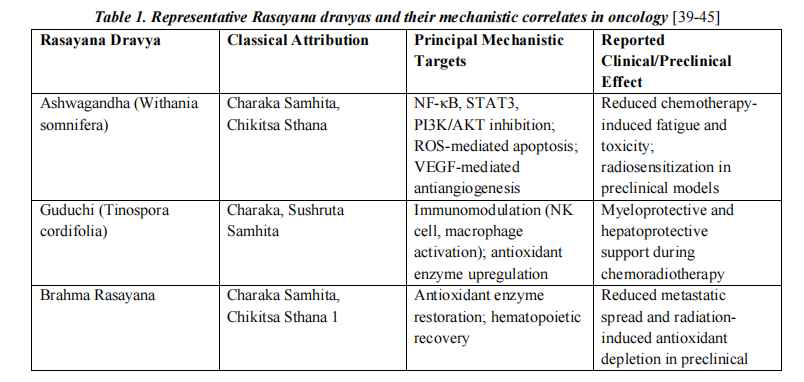
A substantial body of preclinical evidence indicates that classical Rasayana dravyas exert antioxidant effects through upregulation of endogenous antioxidant enzymes (superoxide dismutase, catalase, glutathione peroxidase) and scavenging of reactive oxygen species (ROS) generated by chemotherapy and ionising radiation.
Several Rasayana botanicals also modulate pro-inflammatory signalling, prominently nuclear factor-kappa B (NF-κB), a master regulator of inflammatory cytokine expression that is frequently constitutively activated in malignant cells and implicated in chemoresistance. Inhibition of NF-κB activation has been demonstrated for Withaferin A, a principal withanolide of Ashwagandha, contributing to reduced inflammation-driven tumour-promoting signalling [34].
3.2 Pro-apoptotic and Antiproliferative Signalling
Multiple Rasayana-derived phytoconstituents demonstrate induction of apoptosis in malignant cell lines through interaction with key signalling nodes including NF-κB, STAT3, PI3K/AKT, and the Bcl-2/Bax axis. Withaferin A has been shown to induce reactive-oxygen-species-mediated apoptosis selectively in breast cancer cell lines (MCF-7, MDA-MB-231) while sparing normal mammary epithelial cells, with additional reported activity against Hsp90 stabilisation, survivin signalling, and G2/M cell cycle arrest [35].
3.3 Antiangiogenic Effects
Inhibition of vascular endothelial growth factor (VEGF)-mediated angiogenesis has been documented for Withaferin A in experimental tumour models, suggesting a mechanism by which Rasayana constituents may limit the vascular supply necessary for tumour growth and metastatic spread [36].
3.4 Immunomodulation
Guduchi (Tinospora cordifolia) and Ashwagandha have both demonstrated enhancement of natural killer (NK) cell activity and macrophage function in experimental models, supporting the classical Rasayana claim of strengthened Vyadhikshamatva. This immune-enhancing activity is particularly relevant in the context of chemotherapy-induced myelosuppression and immune compromise during survivorship [37].
3.5 Chemo- and Radio-protective Effects
Beyond direct antineoplastic mechanisms, several Rasayana formulations appear to function primarily as cytoprotective adjuvants—mitigating normal-tissue toxicity from chemotherapy and radiotherapy. Brahma Rasayana has been shown in preclinical studies to restore radiation-depleted hepatic antioxidant enzymes and accelerate haematopoietic recovery, while reducing markers of metastatic spread [38].

4. Clinical and Translational Evidence
4.1 Controlled and Observational Studies
A controlled clinical evaluation of Rasayana Avaleha administered alongside chemoradiotherapy in cancer patients reported reduced treatment-related adverse effects compared with chemoradiotherapy alone, supporting the cytoprotective rationale described above. Observational studies of herbomineral Rasayana therapy have similarly reported improvements in quality-of-life metrics among patients with advanced cancer [46-50].
4.2 Case Reports and Case Series
A growing body of case literature describes individualised Rasayana Therapy (ART) protocols used either as adjuvant support alongside conventional treatment or, in selected chemo-intolerant patients, as an alternative approach [51-54]. Reported outcomes include disease-free survival of several years in early-stage breast cancer following Rasayana therapy after surgery in a patient who declined adjuvant chemotherapy, and a documented case of tumour regression in chemo-intolerant stage IV follicular lymphoma managed with Ayurvedic Rasayana Therapy [55-57]. A separate case report described complete tumour regression using an exclusive Rasayana regimen in high-grade diffuse large B-cell lymphoma. These reports, while methodologically limited to single-patient observations, are noteworthy for documenting imaging-confirmed outcomes and standardised performance-status assessment (ECOG) [58-60].
4.3 Synthesis Across the Evidence Base
Recent narrative reviews converge on a consistent picture: preclinical evidence for multi-targeted anticancer and cytoprotective activity of Rasayana botanicals is extensive and mechanistically coherent, whereas clinical evidence remains largely confined to small trials, observational cohorts, and case reports rather than adequately powered randomised controlled trials [61-62]. A 2025 review specifically addressing Rasayana therapy in cancer prevention and survivorship concluded that clinical use shows particular promise in improving quality of life, reducing cancer-related fatigue, and mitigating chemotherapy-induced toxicities such as myelosuppression and neuropathy, with additional potential for chemosensitising and radioprotective effects [63-66].
5. Discussion
The convergence between the classical Ayurvedic construct of Vyadhikshamatva and the modern survivorship-care goals of immune restoration, toxicity mitigation, and quality-of-life improvement provides a coherent rationale for integrating Rasayana Chikitsa into supportive oncology. Mechanistically, the multi-targeted activity of Rasayana phytoconstituents—spanning antioxidant, anti-inflammatory, pro-apoptotic, antiangiogenic, and immunomodulatory pathways—contrasts with the single-target specificity of most conventional oncological agents, and may explain reported synergy with chemoradiotherapy in reducing normal-tissue toxicity.
However, several limitations constrain translation into clinical guidelines. Most clinical data derive from small, often single-centre studies or individual case reports without randomisation or blinding, limiting causal inference. Standardisation of herbal formulations, variability in withanolide and other active-constituent content across sources, and limited pharmacokinetic and bioavailability data further complicate dose-response interpretation [67-68]. Drug-herb interaction potential, particularly with concurrent chemotherapeutic agents, also requires systematic evaluation, as multi-targeted immunomodulation could theoretically interfere with certain mechanisms of cytotoxic or immunotherapeutic agents.
Future research priorities include adequately powered randomised controlled trials with standardised Rasayana formulations, validated patient-reported outcome measures (e.g., EORTC QLQ-C30) alongside classical Ayurvedic assessment parameters, pharmacovigilance studies addressing herb-drug interactions, and mechanistic studies correlating Dosha-Prakriti-based patient stratification with biomarker response—an approach consistent with the personalised-medicine direction of contemporary oncology [69].
6. Conclusion
Rasayana Chikitsa offers a biologically plausible and classically well-grounded adjuvant strategy for cancer survivorship care, supported by robust preclinical evidence of multi-targeted antioxidant, anti-inflammatory, pro-apoptotic, antiangiogenic, and immunomodulatory activity. Early clinical signals suggest benefit in reducing chemoradiotherapy-related toxicity and improving quality of life, but the evidence base remains predominantly preclinical and observational. Larger, methodologically rigorous clinical trials are needed before Rasayana therapy can be recommended as a standard component of integrative survivorship care, though its low-toxicity profile and mechanistic coherence justify continued structured clinical investigation.
References
1. Sung H, Ferlay J, Siegel RL, Laversanne M, Soerjomataram I, Jemal A, et al. Global cancer statistics 2022: GLOBOCAN estimates of incidence and mortality worldwide for 36 cancers in 185 countries. CA Cancer J Clin. 2024;74(3):229-263.
2. World Health Organization. Cancer. Geneva: World Health Organization; 2025.
3. Miller KD, Nogueira L, Mariotto AB, Rowland JH, Yabroff KR, Alfano CM, et al. Cancer treatment and survivorship statistics, 2019. CA Cancer J Clin. 2019;69(5):363-385.
4. Greenlee H, DuPont-Reyes MJ, Balneaves LG, Carlson LE, Cohen MR, Deng G, et al. Clinical practice guidelines on the evidence-based use of integrative therapies during and after breast cancer treatment. CA Cancer J Clin. 2022;72(5):540-580.
5. Charaka Samhita. Edited by Yadavji Trikamji Acharya. Varanasi: Chaukhambha Surbharati Prakashan; Reprint 2023.
6. Sushruta Samhita. Edited by Yadavji Trikamji Acharya. Varanasi: Chaukhambha Surbharati Prakashan; Reprint 2023.
7. Thatte UM, Dahanukar SA. Rasayana concept: clues from immunomodulatory therapy. In: Upadhyay SN, editor. Immunomodulation. New Delhi: Narosa Publishing House; 1997. p.141-148.
8. Vyas P, Thakar AB, Baghel MS, Sisodia A, Deole Y. Efficacy of Rasayana Avaleha as adjuvant to radiotherapy and chemotherapy in reducing adverse effects. AYU. 2010;31(4):417-423. (ResearchGate)
9. Upadhyay AK, Kumar K, Kumar A, Mishra HS. Tinospora cordifolia (Guduchi): validation of the Ayurvedic pharmacology through experimental and clinical studies. Int J Ayurveda Res. 2010;1(2):112-121.
10. Sharma U, Bala M, Kumar N, Singh B, Munshi RK, Bhalerao S. Immunomodulatory active compounds from Tinospora cordifolia. J Ethnopharmacol. 2012;141(3):918-926.
11. Hahm ER, Moura MB, Kelley EE, Van Houten B, Shiva S, Singh SV. Withaferin A-induced apoptosis in human breast cancer cells is mediated by reactive oxygen species. PLoS One. 2011;6(8):e23354.
12. Stan SD, Hahm ER, Warin R, Singh SV. Withaferin A causes FOXO3a- and Bim-dependent apoptosis and inhibits growth of human breast cancer cells in vivo. Cancer Res. 2008;68(18):7661-7669.
13. Yu Y, Hamza A, Zhang T, Gu M, Zou P, Newman B, et al. Withaferin A targets heat shock protein 90 in pancreatic cancer cells. Biochem Pharmacol. 2010;79(4):542-551.
14. Rasool M, Varalakshmi P. Immunomodulatory role of Withania somnifera root powder on experimentally induced inflammation: an in vivo and in vitro study. Vascul Pharmacol. 2006;44(6):406-410.
15. Devi PU, Sharada AC, Solomon FE, Kamath MS. In vivo growth inhibitory effect of Withania somnifera on transplantable mouse tumors, Sarcoma-180. Indian J Exp Biol. 1992;30(3):169-172.
16. Devi PU, Ganasoundari A. Radioprotective effect of Brahma Rasayana in mice exposed to whole-body gamma irradiation. Indian J Exp Biol. 1999;37:124-129.
17. Ganasoundari A, Devi PU. Modification of radiation-induced micronucleus formation by Brahma Rasayana. Mutat Res. 2000;466(1):127-135.
18. Bendale YN, Kadam A, Patil A, Birari-Gawande PK. Complete tumor regression with exclusive Ayurvedic Rasayana regimen in high-grade diffuse large B-cell lymphoma: a case report. Clin Case Rep. 2022;10(4):e05696.
19. Sharma R, et al. Ayurveda Rasayana Therapy leads to tumor regression and increased survival in chemo-intolerant high-grade stage IV follicular lymphoma: a case report. Medicine (Baltimore). 2024.
20. Aaronson NK, Ahmedzai S, Bergman B, Bullinger M, Cull A, Duez NJ, et al. The European Organization for Research and Treatment of Cancer QLQ-C30: a quality-of-life instrument for use in international clinical trials in oncology. J Natl Cancer Inst. 1993;85(5):365-376.
21. Cella DF, Tulsky DS, Gray G, Sarafian B, Linn E, Bonomi A, et al. The Functional Assessment of Cancer Therapy scale: development and validation of the general measure. J Clin Oncol. 1993;11(3):570-579.
22. Lyman GH, Greenlee H, Bohlke K, Bao T, DeMichele AM, Deng GE, et al. Integrative therapies during and after cancer treatment: ASCO guideline update. J Clin Oncol. 2022;40(22):2498-2513.
23. Kumar S, Mathew SO, Aharwal RP, et al. Withaferin A: a pleiotropic anticancer agent from the Indian medicinal plant Withania somnifera (L.) Dunal. Pharmaceuticals (Basel). 2023;16(2):160.
24. Singh N, Bhalla M, de Jager P, Gilca M. An overview on Ashwagandha: a Rasayana (rejuvenator) of Ayurveda. Afr J Tradit Complement Altern Med. 2011;8(5 Suppl):208-213.
25. Patwardhan B, Mutalik G, Tillu G. Integrative Approaches for Health: Biomedical Research, Ayurveda and Yoga. London: Academic Press; 2015.
26. Gandhi MY, Prasad SB, Kumar V, Soni H, Rawat H, Mishra SK, Grewal J, Singh S, Charde V, Gupta A, Jha SK. Quantification of phytochemicals and metal ions as well as the determination of volatile compounds, antioxidant, antimicrobial and antacid activities of the Mimosa pudica L. leaf: Exploration of neglected and under-utilized part. Chemistry & biodiversity. 2023 Oct;20(10):e202301049.
27. Shamim, Ali S, Ali T, Sharma H, Kishor BN, Jha SK. Recent advances in monodisperse gold nanoparticle delivery, synthesis, and emerging applications in cancer therapy. Plasmonics. 2025 Sep;20(9):7121-41.
28. Gandhi Y, Kumar V, Singh G, Prasad SB, Mishra SK, Soni H, Rawat H, Singh S, Charde V, Gupta A, Dhanjal DS. Chemoprofiling and medicinal potential of underutilized leaves of Cyperus scariosus. Scientific Reports. 2024 Mar 27;14(1):7263.
29. Jha SK, Islam M, Kumar R, Rana L, Saifi MA, Ali S, Alam N. Evaluation of Vernonia amygdalina del. containing phyto constituents a medicinal plant compound as new potential inhibitors of Monkey pox virus using molecular docking analysis. World J Adv Res Rev. 2023;17(1):1112-22.
30. Singh A, Jha SK, Dwivedi PC, Srivastava U, Pal A. Revolutionizing healthcare: Integrating electronics, AI, traditional, and conventional methods. World J Adv Res Rev. 2024;23:2426-34.
31. Lohiya GV. Conjunctivitis in unusual populations: A review of rare cases and challenges in diagnosis and management. World Journal of Advanced Research and Reviews. 2023 Sep 29.
32. Lohiya GV. Conjunctivitis in unusual populations: A review of rare cases and challenges in diagnosis and management. World Journal of Advanced Research and Reviews. 2023 Sep 29.
33. Doshi R, Lohiya G. Synthesis, in-silico design and spectral characterization, elucidation of Cannabis sativa L. cannabaceae containing phytoconstitutents demonstrating novel therapeutic efficacy against epilepsy.
34. Jha SK, Mishra AK, Kumar V, Dane G, Kumari S, Charde V, Saddam M, Jagtap C, Chuhan S, Chaturvedi SK, Narasimhaji CV. Ecological and Behavioral Impacts of COVID-19 on Human Existence and potential preventive measures through traditional and alternative medicine–A Narrative review. Pharmacological Research-Natural Products. 2024 Jun 1;3:100042.
35. Sonkar V, Jha SK, Tiwari S, Akarsh A, Priya S, Sharan P, Sharan A. Characterization and explanation of the soil fertility state of Sakaldiha block in the Chandauli District of Uttar Pradesh’s industrial area. World J Adv Res Rev. 2023;18:063-72.
36. Singh NK, Sengar AS, Jha SK. A review of Ayurvedic measures for preventing COVID-19 and promoting health during pregnancy. Journal of Indian System of Medicine. 2024 Apr 1;12(2):61-5.
37. Chauhan S, Jha SK, Tamta A, Sharma V, Kumar C, Lohiya G, Gadgul A, Satpute K, Chalmale N, Chauhan P, Chaturvedi SK. Descriptive analytical study based on profiling, morphological, pomological and pharmacological traits to identify the genotypes of the promising mango Mangifera indica L. World J Adv Res Rev. 2023;19:1544-53.
38. Khan R, Maheshwari D, Chauhan S, Lohiya GV, Kumar C, Antil I, Sharma S, Garg Y, Chauhan P, Jha SK. Exploring the potential therapeutic value of Solanum lycopersicum L. phytoconstituents for Parkinson’s disease through molecular docking analysis. World J Adv Res Rev. 2023;20:488-501.
39. Jha SK, Singh N, Shanker OR, Antil I, Baghel JS, Huddar V, Tripathi R. A review on integrative approaches in oncology: bridging ayurvedic medicine and modern cancer therapeutics. Frontiers in Natural Products. 2025 Aug 22;4:1635197.
40. Tamta A, Jha SK. Screening of Germplasms and Population Dynamics of Major Insect Pests of Spring Green Gram Vigna radiata (Linn.) (Doctoral dissertation, Doctoral Dissertation, Doctoral Dissertation, GB Pant University of Agriculture and Technology, Pantnagar-263145 (Uttarakhand)).
41. Mehta V, Zargar AA, Attri P, Jha SK. Bagging the role of herbal drugs in the management of cervical cancer. Ayush Journal of Integrative Oncology. 2025 Jan 1;2(1):35-43.
42. Trivedi LM, Saxena S, Sharma S, Beniwal M, Jha SK, Rao AK, Khan MR. Characterization, profiling, and molecular docking analysis of phytochemicals derived from Daucus carota for evaluating their potential role in cardiovascular disease (CVD) assessment. World J Adv Res Rev. 2023;20:159-75.
43. Patel S, Singh S, Gupta AK, Dalimbe AY, Muthoju SM, Pawar AR, Jha SK, Gupta AJ. Ayurveda and common Indian spices: A natural alternative for cancer therapy. Ayush Journal of Integrative Oncology. 2025 Apr 1;2(2):91-102.
44. Jha SK, Gupta A, Huddar VG. Botanical breakthroughs: The growing impact of plant-derived compounds in cancer treatment. Ayush Journal of Integrative Oncology. 2025 Apr 1;2(2):62-7.
45. Kumar R, Verma H, Ali M, Midha T, Kumar D, Jha SK. Review of mitigating cancer risk through Ayurvedic practices: A holistic approach to combating sedentarism. Ayush Journal of Integrative Oncology. 2025 Apr 1;2(2):86-90.
46. Sharma A, Jha SK, Huddar VG. Integrative role of Ayurvedic phytochemicals in cancer treatment: Targeting signaling pathways, boosting chemosensitivity, and utilizing traditional therapeutics. Ayush Journal of Integrative Oncology. 2025 Apr 1;2(2):77-85.
47. Jha SK, Charde V, Kumar V, Narasimhaji CV. Vitiligo treatment with natural bioactive: A narrative review. The Natural Products Journal. 2026 Mar;16(3):e22103155337960.
48. Chawla S, Gupta R, Jha SK, Kashid S, Jha KT. Stereoisomerism in Chemistry and Drug Development: Optical, Geometrical, and Conformational Isomers. Medicinal Chemistry (Shariqah (United Arab Emirates)). 2025.
49. Shrivastav S, Tyagi R, Singh M, Jha S. The effectiveness of curcumin on dysmenorrhea. International Journal of Medical Sciences and Pharma Research. 2022 Dec 15;8(4):8-12.
50. Gupta AJ, Huddar VG, Jha SK, Soni U. Traditional wisdom in modern oncology: Ayurvedic pain relief and supportive care. Ayush Journal of Integrative Oncology. 2025 Jul 1;2(3):178-87.
51. Chauhan S, Jha SK, Huddar VG, Ahlawat A, Sharma S, Tripathi A, Khurana B, Antil I, Soni U. Targeting cancer at the molecular level: A biochemical and medicinal chemistry approach. Ayush Journal of Integrative Oncology. 2025 Jul 1;2(3):169-77.
52. Antil I, Bangarwa S, Jha SK, Gupta AJ, Soni U, Huddar VG, Tripathi A, Sharma S. Exploring the chemopreventive and anticancer effects of green tea. Ayush Journal of Integrative Oncology. 2025 Jul 1;2(3):158-68.
53. Attri P, Zargar AA, Mehta V, Mushtaq SU, Jha SK, Soni U. Genetic basis of cancer: Harnessing natural remedies for therapeutic potential. Ayush Journal of Integrative Oncology. 2025 Jul 1;2(3):188-94.
54. Zargar AA, Mehta V, Gupta R, Bhandari K, Sharma MC, Balaji P, Jha SK. Incretin hormones: Mechanisms, therapeutic implications, and future directions in glucose regulation and diabetes management. Curr Proteom. 2025 Apr 1;22:100014.
55. Dhiman S, Thakur N, Dwivedi PC, Pande P, Jha SK, Lohiya GV. Phytochemicals: investigating bioactive compounds for antifungal uses and quality issues in functional foods and therapeutics.
56. Sandrepogu J, Khandelwal P, Tiwari SK, Jha SK, Chauhan S, Sharma H, Goel P. A holistic paradigm for cancer care: Merging Ayurveda with contemporary oncology. Ayush Journal of Integrative Oncology. 2025 Oct 1;2(4):254-61.
57. Sharma S, Yadav C, Chawla S, Jha SK. Beyond chemotherapy: Exploring the potential of phytomedicine in oncology. Ayush Journal of Integrative Oncology. 2025 Jul 1;2(3):133-45.
58. Ahlawat A, Chauhan S, Antil I, Jha SK, Huddar VG. Examining the impact of the microbiome on cancer immunotherapy outcomes: A review. Ayush Journal of Integrative Oncology. 2025 Jul 1;2(3):118-24.
59. Shamim PT, Khatri N, Yadav AK, Mishra B, Khan MR, Behera SK, Jha SK. Role of human chorionic gonadotropin in frozen-thawed embryo transfer cycles for secretory transformation: a narrative. Eur Chem Bull. 2023;12(8):5477-93.
60. Sharma H, Mahto RR, Jha SK, Chauhan S, Khandelwal P, Tiwari SK. Rasayana-Based Adjuvant Strategies in Cancer Care: An Ayurvedic–Oncologic Perspective. Iranian Journal of Blood and Cancer. 2025 Feb 30;17(4):35-68.
61. Raj H, Jha SK, Negi M, Khandelwal P, Chauhan S, Sharma H, Goel P, Tiwari SK. Integrative oncology: A comprehensive comparative analysis of herbal and allopathic medicine in cancer treatment. Current Pharmaceutical Research (CPR). 2025;1:427-5.
62. Kumar C, Chauhan P, Chauhan S, Jha SK, Lohiya G. Phyto-Pharmacognostic Experimental Study of Epimedium Sagittatum and Gloriosa Superba L. for the Treatment of Hypogonadism. Int J Innov Sci Res Technol. 2023;8(6):254-60.
63. Raj H, Sharma S, Tripathi A, Huddar VG, Jha SK. Herbal medicine in cancer therapy: A comprehensive review of phytoconstituents, mechanisms, and clinical applications. Ayush Journal of Integrative Oncology. 2025 Jul 1;2(3):146-57.
64. Antil I, Jha SK, Negi M, Sharma H, Tiwari SK. Baicalein from Scutellaria baicalensis as natural therapeutic agent for glioblastoma. Current Pharmaceutical Research (CPR). 2025;1:411-26.
65. Mandal P, Kumar J, Bora D, Hashmi SA, Tiwari M, Gupta R, Behera AK, Amoli M, Singh J, Jha SK. Literature review on forensic implications of illicit drug metabolism: A medicinal chemistry perspective. Journal of Forensic and Legal Medicine. 2026 Apr 24:103158.
66. Bansal KS, Mahto RR, Soni H, Tiwari SK, Goel P, Sharma H, Vishwakarma N, Jha SK, Chauhan S, Khandelwal P. Ayurveda in Renal Cell Carcinoma: A Narrative Review of Supportive Care During Targeted Therapy and Immunotherapy.
67. Bansal KS, Mahto RR, Soni H, Tiwari SK, Goel P, Sharma H, Vishwakarma N, Jha SK, Chauhan S, Khandelwal P. Ayurveda in Renal Cell Carcinoma: A Narrative Review of Supportive Care During Targeted Therapy and Immunotherapy.
68. Mahto RR, Bansal KS, Soni H, Tiwari SK, Sandrepogu J, Bhatted SK, Jha SK, Sharma H, Khandelwal P. Efficacy of Vidangadi Loha and Phalatrikadi Ghanavati with and without the prior administration of Virechana Karma in Madhumeha (Obese Diabetic): A Randomised Controlled Trial.
69. Pandey K, Negi M, Tiwari A, Tiwari SK, Sharma H. Turmeric: The golden shield of nature that can treat cancers. Journal of Health Synapse (JHS). 2026;1(1):1-8.
Authors: Priya Goelᵃ*, Sanjay Kumar Tiwariᵇ, Sonam Chauhanᵃ, Prachi Khandelwalᵃ, Himani Sharmaᶜ
Affiliations:
ᵃ Department of Kayachikitsa, All India Institute of Ayurveda, New Delhi – 110076.
ᵇ Department of Kayachikitsa, Bhartiya Ayurvedic Medical College, Gajraula, Amroha, Uttar Pradesh.
ᶜ Department of Shalakya Tantra, Sanjeevani Ayurvedic Medical College, Gajraula, Amroha, Uttar Pradesh.